
2026 has been an unusually eventful year for investors, marked by a series of major developments, each significant enough to reshape the market outlook on its own. A war in the Middle East, a return of inflation, the Federal Reserve’s first rate hike in three years, artificial intelligence’s outsized role in reshaping the market (and the recent wobble that followed), and a midterm election just a week away have all competed for investors’ attention. Remarkably, markets have not only absorbed these developments but thrived, with the S&P 500 up roughly 14% for the year through early October and trading near record highs. In this update, we walk through the themes dominating today’s investment environment, the key unknowns attached to each, and most importantly, where we see opportunities moving forward.
The Headlines Driving 2026
The Iran War and the Return of Inflation
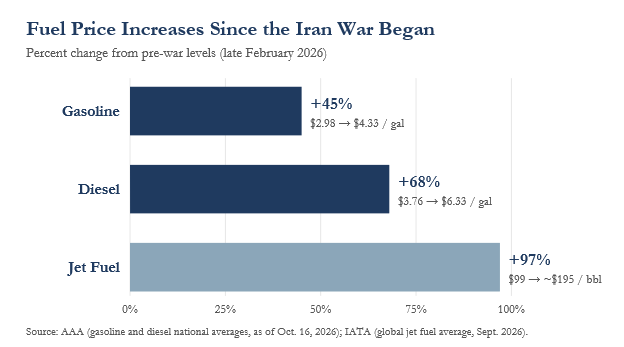
The conflict between Iran and the U.S., which began in late February, has significantly impacted markets and the economy. The closure of the Strait of Hormuz, a shipping route for more than 20% of the world’s oil, sent Brent crude to roughly $118 per barrel in late March. Prices have whipsawed since then, falling near $70 per barrel in early July before climbing back above $100 as attacks on shipping and energy infrastructure resumed. For households, the impact is tangible: according to AAA, the national average price for gasoline is up about 45% since the war began, and diesel is up roughly 68%. The latter is especially notable since Diesel fuel is used to transport everyday goods and services – creating more widespread inflation. Additionally, consumer prices rose 3.7% year-over-year in September, up from 3.4% in August, marking the largest monthly increase since the early days of the conflict.
The Fed Changes Course
A year ago, the conversation centered on how quickly the Federal Reserve would cut interest rates. Today, it is about how far it may raise them. On September 16, the Fed, now led by Chairman Kevin Warsh, unanimously raised its benchmark rate by a quarter percentage point to a range of 3.75% to 4.00%, its first increase since 2023. Futures markets are now pricing in a strong likelihood of another rate hike in December. The bond market has moved even faster with the 10-year Treasury yield climbing above 5.2% in early October, its highest level in roughly two decades, before easing slightly. Higher long-term rates ripple across the economy, raising mortgage and borrowing costs for households, making it more expensive for companies to refinance debt and fund growth, and lowering the valuations investors are willing to pay for future corporate earnings.
Artificial Intelligence: The Market’s Dominant Theme
Every bull market has a leadership story, and this one belongs to artificial intelligence. Since the current bull market began in late 2022, AI has been the single most powerful force in the market, and its influence has only grown. Semiconductor companies supplying the chips that power AI models have been among the market’s biggest winners, and the ten largest companies now represent close to 38% of the S&P 500, a level of concentration rarely seen. AI’s influence extends well beyond technology, lifting utilities and power producers, industrial and construction firms building data centers, and energy companies meeting surging electricity demand. Not every company has benefited, however. Many software companies have come under pressure as investors question whether AI tools will disrupt their traditional business models. In recent weeks, we have also seen how quickly sentiment can shift, as questions around AI revenue and the debt being used to finance the buildout triggered sharp, if short-lived, selloffs in technology names.
The Midterm Elections
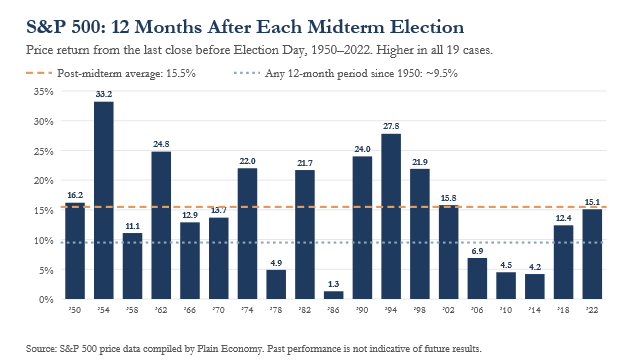
Americans head to the polls on November 3rd with gas prices and cost-of-living pressures front of mind for voters. Midterm years have historically been bumpy for markets, as the president’s party tends to lose seats and policy uncertainty rises. It is worth remembering, however, that markets have often performed well in the year following a midterm election, once that uncertainty clears. As the chart below shows, the S&P 500 has been higher 12 months after every midterm election since 1950.
Forecasting the Future: A Lesson in Humility
Each of these themes presents investors with two distinct challenges. The first is anticipating what will actually happen: whether the Iran conflict ends, whether inflation cools, whether AI spending pays off, and which party controls Congress. The second, and often the harder of the two, is predicting how markets will react, since prices can move in unexpected ways even when the outcome itself is called correctly. Looking ahead is essential, but so is recognizing the limits of any forecast.
History offers plenty of examples where investors got the first layer right, only to be surprised by the second. The 2020 election and what sectors performed well is a prime example of this. Following President Biden’s victory, the consensus view held that a clean-energy agenda would weigh on oil and gas companies. Instead, energy was the best-performing sector of the S&P 500 in both 2021 and 2022, gaining roughly 50% or more each year, as the reopening of the economy, and then Russia’s invasion of Ukraine sent oil prices soaring. A war few had predicted had a far greater impact on energy stocks than a change in the White House. With that said, the table below outlines a few scenarios we are monitoring and the areas of the market that could be helped or hurt in each.
| Theme | A Scenario That Could Help | A Scenario That Could Hurt |
|---|---|---|
| Iran War & Oil | A durable ceasefire reopens the Strait of Hormuz. Lower fuel costs would likely benefit consumer discretionary companies, airlines, transportation, and energy-importing economies in Europe and Asia. | A prolonged conflict keeps oil above $100. Energy producers and defense contractors may benefit, while consumers, transportation, and fuel-intensive industries feel the squeeze. |
| Fed & Interest Rates | Inflation cools and the Fed pauses. Long-duration growth stocks, small caps, real estate, and existing bond holdings would likely benefit from falling yields. | Inflation proves sticky and the Fed keeps hiking. Housing, small caps, and highly leveraged companies could struggle, while cash and short-term bonds become more competitive. |
| AI Investing | AI spending translates into real revenue and productivity gains. Semiconductors, cloud providers, and power and utility infrastructure could continue to lead. | Returns on AI spending disappoint or financing tightens. The largest technology names would be most exposed, while value-oriented and international stocks may hold up better. |
| Midterm Elections | A clear, uncontested result that produces a divided government. Gridlock in Washington tends to limit sweeping legislation and policy surprises, an environment markets have historically welcomed. | A contested outcome or sharp shift in priorities on drug pricing, energy, or trade, creating volatility in healthcare, energy, and trade-sensitive sectors. |
We do not present these scenarios as predictions, which is precisely why we believe portfolios should be built to withstand a range of outcomes rather than positioned around a single outcome.
Investment Opportunities Moving Forward
If predicting how markets will respond is so difficult, it is fair to ask why we highlight opportunities at all. The answer is that we do not need to forecast the future to find value in the present. Uncertainty tends to push prices to levels that already reflect investors’ worries, creating opportunities that can be attractive across a range of outcomes rather than depending on a single prediction proving correct. Acknowledging the limits of forecasting, in other words, does not mean standing still. Our market views help guide tactical shifts within a portfolio’s equity, fixed income and alternative sleeves. Within those sleeves, several opportunities we are monitoring include:
Fixed Income: Yields Worth Locking In
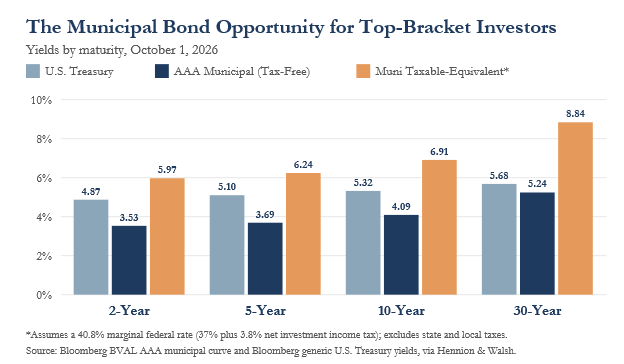
For the first time in many years, bonds are offering high-net-worth investors attractive income. The same inflation and rate pressures that have unsettled markets have pushed yields to levels not seen in roughly two decades, and the municipal bond market has moved even further. Since early July, 10-year AAA municipal yields have risen from roughly 3.00% to nearly 4.00%. Further, the Bloomberg Municipal Bond Index yielded 4.78% at the beginning of October, placing it in the top 1% of yields since 2000 and at a level last seen in 2008. For investors in the top federal bracket, who pay 37% plus the 3.8% net investment income tax, that tax-exempt income is worth considerably more than its stated yield. As the chart below shows, a 30-year AAA municipal bond yielding about 5.2% equates to a taxable-equivalent yield of nearly 8.8%, before any additional benefit from state tax exemptions. This selloff has largely been driven by interest rates, not credit, and state and local finances remain broadly sound. Locking in today’s yields means investors do not need to correctly call the Fed’s next move to earn an attractive return.
The information contained above is for illustrative purposes only.
Continued AI Momentum
Despite recent volatility, the fundamental story behind artificial intelligence remains intact. According to FactSet, analysts expect S&P 500 earnings to grow roughly 33% in 2026, with much of that strength tied to companies building and deploying AI infrastructure. Early third-quarter results support that view, with 84% of companies reporting so far beating earnings estimates. We believe the opportunity extends well beyond the handful of household names leading the market, reaching chipmakers, data center builders, and the utilities and power producers supplying the electricity these facilities require. Furthermore, we anticipate there could be many additional sectors of the market that will benefit from increased productivity that AI may enable. Our approach is to participate thoughtfully, sizing positions so portfolios are not overly dependent on a handful of companies or specific sectors. For investors who already hold concentrated technology positions, reducing that overlap in a tax-efficient way is just as important.
Attractive Valuations Beneath the Surface
Headlines about record highs can obscure a more nuanced picture. In fact, earnings have outpaced prices, so the S&P 500 now trades at about 19 times forward earnings, slightly below its 10-year average. Valuations are even more reasonable outside the market’s largest names: the equal-weighted S&P 500, which gives every company the same weight, traded near 16 times forward earnings at the end of September. Although, through early October, it had also trailed the traditional cap-weighted index by roughly four percentage points this year. Recent weeks have brought early signs that this may be changing, as investors rotate toward health care, consumer staples, energy, and other previously overlooked sectors. International developed markets also continue to trade at a meaningful discount to U.S. stocks. For long-term investors, these overlooked areas of the market offer diversification at reasonable prices, along with the potential to benefit if leadership continues to widen beyond technology.
What Comes Next for Your Family’s Wealth
2026 has given investors no shortage of reasons to worry, and the weeks ahead, with an election, another Fed meeting, and an unresolved conflict, are unlikely to be quiet. Uncertainty is nothing new, and making rash decisions based on headlines is rarely a sound strategy. We recommend that families consider not only the risks, but the opportunities that exist, and most importantly, how to balance those competing forces in a portfolio aligned with their specific financial plan. We welcome the opportunity to help you build a financial plan that serves as your guidepost for a resilient, long-term investment strategy.
Market data cited is as of mid-October 2026 and is subject to change. This commentary is for informational purposes only and should not be considered investment, tax, or legal advice. Past performance is not indicative of future results.
All information has been obtained from sources believed to be reliable, but its accuracy is not guaranteed. There is no representation or warranty as to the current accuracy, reliability or completeness of, nor liability for, decisions based on such information and it should not be relied on as such.
Stage Harbor Financial, LLC (“Stage Harbor”) is a registered investment advisor. Advisory services are only offered to clients or prospective clients where Stage Harbor and its representatives are properly licensed or exempt from licensure.