Turn on the news, scroll through your social media feed, or simply glance at the notifications on your phone, and you will find no shortage of reasons to feel uneasy about the world and, by extension, your financial future. From geopolitical tensions to election cycles to the latest market swing, the drumbeat of unsettling information is relentless and, frankly, it is designed to be. But here is what decades of market history tell us: the loudest headlines have rarely been the most reliable guides for long-term investors. At Stage Harbor Financial, we believe that a well-constructed financial plan, grounded in your personal goals, time horizon, and risk tolerance, is a far more powerful compass than any news cycle. So, before you make your next financial decision based on what you saw on TV, let us help you put it all into context.
Investor Confidence vs Market Returns
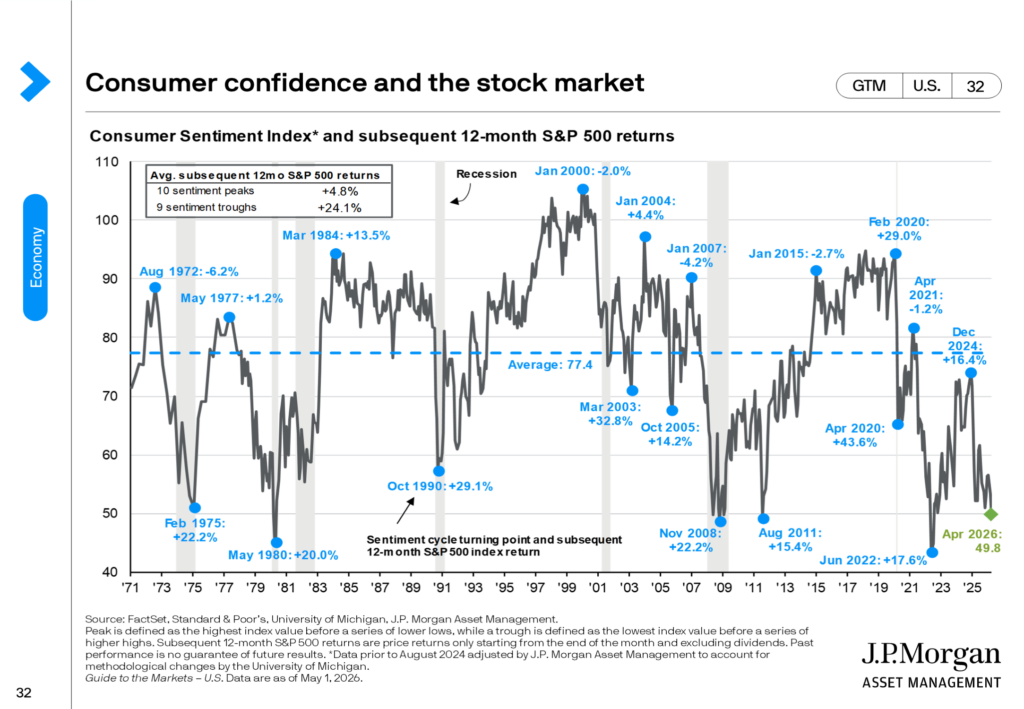
We recognize the impact geopolitical unrest, economic instability, market volatility, and simply the fear of the unknown has on the very real concerns for investors. There is quite often a direct correlation between headline news and personal emotional response. However, stock market performance has historically been less correlated to news headlines and consumer sentiment, as depicted in the chart below (J.P. Morgan May 2026). The chart shows that since the 1970s, when consumer confidence is at its worst, the subsequent 12-month returns (as measured by the S&P 500 for this chart) have been quite robust. Conversely, the chart also shows that when consumer confidence is at its highest levels, the subsequent 12-month returns have tended to be rather meager compared to historical averages. When the markets are flashing red and the headlines and fear are saying to sell, following these trends can impact investors’ returns and derail their goals. As such, we do not let headlines dictate our long-term investment strategy. Our job is to cut through the noise and deliver results to help our clients reach their goals.
The information contained above is for illustrative purposes only.
Behavioral Biases
While this illustration helps us to frame historical environments where consumer confidence rose and fell, we must remember that it represents one data point. Prior to reaching any peak or trough in the chart, it would have been extremely difficult for any investor, pundit, or advisor to say with confidence that the market had reached that level. Rather than try to use a data point to develop a market timing strategy, we believe that this chart is more powerful in helping clients to understand and contextualize their own behavioral biases. By simply naming and understanding these biases (which are often subconsciously working into our decision making), we can help create a better platform from which to make real investment decisions.
- Loss Aversion – simply put, as humans we naturally feel the pain of a loss twice as intensely as we may enjoy the gain. So, when the evening news or the news app on our phone is constantly pinging us with updates of global threats, negative news, and extreme situations, we naturally want to seek shelter and avoid the threat of loss.
- Confirmation Bias – investors tend to seek out information and news sources that support their broader political, social, or local views on a topic. This can create an isolated view of the world, or worse, it can create a situation where small events or statistics take on a disproportionate weight in a decision-making process. This is by no means meant to deride or belittle the heaviness that exists in the news cycle, but when given context around making personal financial decisions, many of these events tend to have little to no impact on the economic results driving the direction of market performance.
- Recency or Availability Bias – with the amount of data we now have access to – from a 24-hour news cycle, to the internet, social media, and AI, our brains need to create shortcuts to synthesize, store and use all of this information. The easiest shortcut for most investors is to overly rely on the most recent piece of data or information they hear. This again can place too much weight on a single data point, often at the risk of ignoring years of historical data and research that may point in a different direction.
- Herding Behavior – herding behavior is when an individual bypasses their own judgment because they believe that the crowd must have information that the individual does not possess. While markets are generally efficient at pricing in known information, there are moments of dislocation where irrational enthusiasm, or panic, drives prices well beyond what fundamentals would justify. It is precisely in these moments that herding behavior is most dangerous, and most tempting.
- FOMO (Fear of Missing Out) – when investors see others rushing into a trending stock, a hot sector, or a viral investment theme, the fear of being left behind can override otherwise sound, goal-oriented thinking. This dynamic is reinforced by social media, financial news, and water cooler conversation, all of which amplify the perception that everyone else is winning while you are standing on the sidelines. We are seeing signs of this play out today, as markets are captivated by artificial intelligence, one of the most talked about investment themes in a generation. Our role is to help you evaluate these moments not through the lens of what everyone else is doing, but through the lens of what is right for your financial plan.
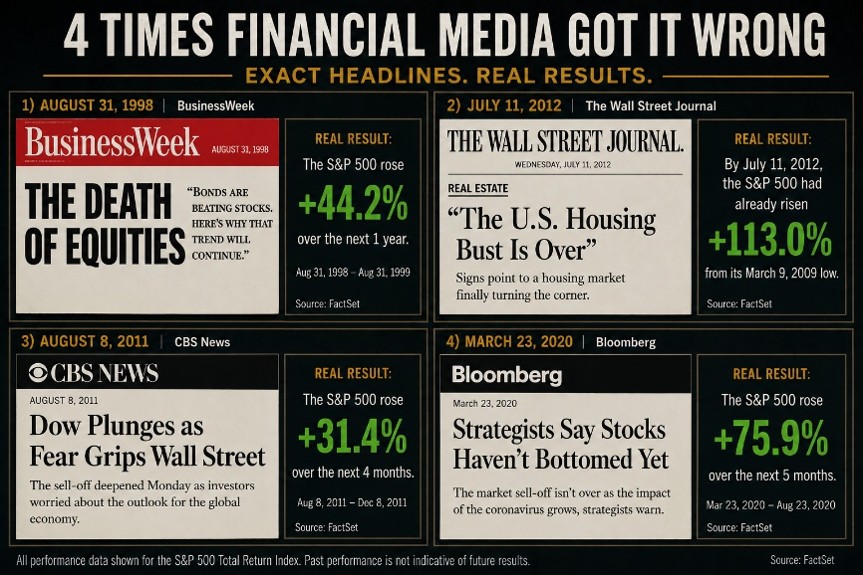
Unfortunately, the state of media today is very good at playing to these behavioral biases. There are many times that media outlets generate eye-grabbing headlines for clicks and to capture your attention, when in reality the topic du jour is often very nuanced and difficult to convey in a four-word headline. The image below shows some of the sensationalized headlines of the past and the corresponding market returns.
The information contained above is for illustrative purposes only.
The behavioral biases described above are not character flaws; they are human responses to an uncertain world. But left unchecked, they can quietly erode even the most carefully constructed financial plan. Stage Harbor’s role is to serve as a steady hand when the noise grows loudest: to help you recognize when a headline is pulling you off course, and to keep your financial plan, not the news cycle, as the governing force behind every decision.
To that end, if you find that you are too often chasing the herd, making decisions based on fear, greed, or headline-driven data points, without an objective relationship to your financial plan, please reach out to one of our financial advisors. We are here to help you clear the fog of confusion, place intent behind your financial decisions, and develop a strategy to stick with no matter what the sensational headline of the day happens to be.
The information provided is for educational and informational purposes only and does not constitute investment advice and it should not be relied on as such. It should not be considered a solicitation to buy or an offer to sell a security. It does not take into account any investor’s particular investment objectives, strategies, tax status or investment horizon. You should consult your attorney or tax advisor.
All information has been obtained from sources believed to be reliable, but its accuracy is not guaranteed. There is no representation or warranty as to the current accuracy, reliability or completeness of, nor liability for, decisions based on such information and it should not be relied on as such.
Stage Harbor Financial, LLC (“Stage Harbor”) is a registered investment advisor. Advisory services are only offered to clients or prospective clients where Stage Harbor and its representatives are properly licensed or exempt from licensure.
For additional information, please visit our website at www.stageharborfinancial.com.